|
|
|
|
| |
 Food / Clothing / Housing
 |
|
| |
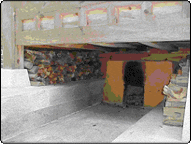
Winter
weather in Goguryeo(Koguryo) was very cold. So, a warm dwelling
environment was very important in their lives. Goguryeo(Koguryo)
people invented the "ondol [meaning: Warm Stone]"
heating system in which a floor stone is heated
by burning fire at one end of the room with the
smoke traveling underneath and exiting at the other
end, making the living space warm. The system was
widely used in palaces, temples and military posts,
as well as houses of ordinary citizens. Ondol heating
that is in use at most of the contemporary Korean
dwellings today originated from Goguryeo(Koguryo). However,
in Goguryeo(Koguryo), only part of a large room had hot-floors
heated by this method. Other furniture such as wooden
tables, beds or chairs were placed in other parts
of the room so that people could sleep at night
or sit around for daily routines. |
|
 |
| |
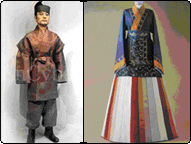
Comfortable jackets and
trousers for outdoor activities were the basic garments
for Goguryeo(Koguryo) men. Unlike Chinese men who wore skirts,
Goguryeo(Koguryo) men wore trousers that were favorable for
horse riding like nomadic people of the northern
region. They closed the front of a jacket to the
left and tied the waist without buttons. This style
was intended to increase efficiency and convenience
when shooting arrows.
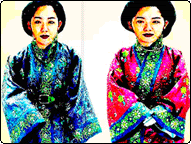
Women wore a variety of skirts such as pleated,
rainbow-striped or polka-dot skirts. But they also
wore comfortable trousers. Often they would enjoy
wearing outer robes adorned with bright patterns.
 pic) men jacket, women
korea dress
pic) men jacket, women
korea dress
Most Goguryeo(Koguryo) men wore a topknot hairstyle and a
hat. Women wore various hairstyles and sometimes
used wigs. In Goguryeo(Koguryo), colorful clothing styles
flourished as a variety of clothing materials including
silk was produced thanks to its advanced dying technology.
Even serfs wore colorfully patterned clothes. Generally,
men preferred comfortable and practical clothes,
and women liked to wear comfortable yet beautiful
dresses. |
|
| |
Goguryeo(Koguryo) people enjoyed
diverse diets. Rice, beans and millet were staple
grains, while barley, wheat and Indian millet served
as a subsidiary diet. Toward the latter period of
the kingdom, consumption of rice increased. With
regard to diet of the early period, they ate hot
gruel by grinding up grains and boiling them with
water in earthenware (like "grits"). They
soon switched to grains steamed in an earthenware
steamer, and then they learned to boil rice in a
cauldron (which is the way Koreans cook rice today).
The representative Goguryeo(Koguryo) dish was "maeg-jeok,
or roasted meat with seasonings. This is the predecessor
of today's "bulgogi" (roast beef), one
of the most famous Korean dishes. A dinner table
of Goguryeo(Koguryo) people would consist of half a dozen
different foods prepared in
various-sized dishes, including fine dinnerware
called "judu," on a table called
"joban." They ate their meals with spoons
and chopsticks. |
|
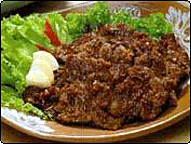
pic) Bulgogi |
| |
They also used a small
knife called "ojado" to cut meat into
small pieces. They would also have cabbage, lettuce
and radish preserved with salt. In later generations,
people would add red peppers to the dish, and this
is the origin of Korea's world famous "kimchi"
(fermented vegetable dish). The home of beans, Goguryeo(Koguryo)
would use beans to make various sauces made from
beans, like soybean paste and soy sauce. They also
enjoyed brewing rice wines.
[Source : Korea.Net]
|
|
|
|