|
|
|
|
| |
 General Ulji, Mundeok
 |
|
| |
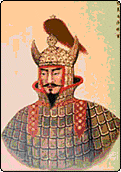
pic) General Ulji, Mundeok
|
Emperor
Yang of the seventh century Sui Dynasty sent one
million troops, 305,000 of which were elite soldiers
to attack Goguryeo(Koguryo). When they arrived at the Yalu,
General Uljimundeok went to the Chinese camp to
assess the situation. There were discussions among
the Chinese, who spotted him, as to whether they
should take him prisoner, but he escaped. The
general who saw the dismal condition of the troops
advised them to go home, but the Chinese attacked
and were decimated at the Chungchon River, north
of present day Pyongyang. A history book praised
the general, noting that only 2,700 Chinese returned
home.
[Source: Chosun Ilbo]
|
|
| |
|
Goguryeo(Koguryo) maintained a standing army of about 50,000
men that would grow to more than 300,000 men in
times of war. General Ulchi Mundok (峙� ) commanded
an army of 300,000. Unlike most armies of the era
in which soldiers were jack-of-all-trades, the Goguryeo(Koguryo)
army was made of specialists: archers, crossbow-men,
spear-man, catapult operators, horsemen, wall-climbers,
and so on.
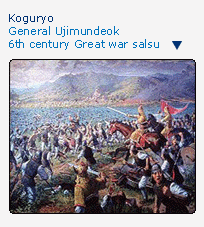
In 612 AD, a Su army of over one million men (about
1,113,800) invaded Goguryeo(Koguryo). Genral Unchi Mundok
deployed his outnumbered men along the southern
bank of the Yalu river. He 'surrendered' to the
enemy in order to spy on the enemy strength. After
learning that the Su soldiers were tired and demoralized,
the general escaped across the Yalu.
He feigned defeat after defeat in order to lure
the enemy deep in the friendly territory to tire
them and stretch the enemy supply lines. The enemy
took the bait and came within 30 ri from Pyongyang.
The enemy chief, Wu Jung-mu realized the futility
of going any further and ordered his army to turn
back and go home. This was exactly what General
Ulchi Mundok expected and the Goguryeo(Koguryo) forces fell
on the retreating Sue troops, inflicting heavy casualties.
[Source: KimSoft]
|
|
|
|
|