|
|
|
|
| |
 Religion
 |
|
| |
Religion
played a significant role in the life of Goguryeo(Koguryo)
people. They not only held memorial rites for ancestors
frequently but also worshipped them as supernatural
beings, or gods. King Chumo, the founder of the
kingdom, and his mother, Lady Yuhwa, were examples
in point. They were anointed respectively as the
"God of Godeung" and the "Goddess
of Buyeo" after their deaths and were subsequently
remembered and revered at the Dongmaeng Festival,
the kingdom's largest annual festive event. The
people at the time believed that the king was an
offspring of God of Heaven, the god of the highest
standing among the people. That the kingdom was
founded by the son of the highest god meant that
their country was the most divine of all, a belief
that was the key source of national pride for the
people. It was in this context that the people of
Goguryeo(Koguryo) kept performing rituals during the Dongmaeng
festivals, which were designed to confirm and deepen
the faith that King Chumo had indeed been a god's
descendent who was born on the land of their kingdom.
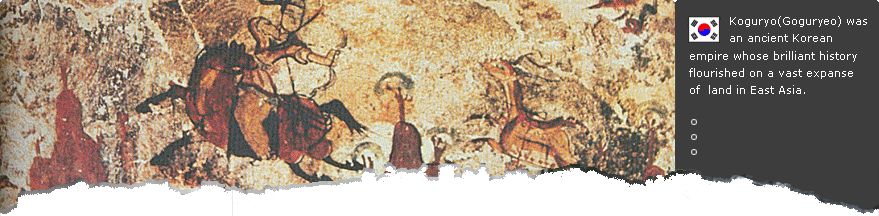
In their (religious) belief, the citizens of Goguryeo(Koguryo)
thought that the deceased would continue his or
her life in an afterlife; this belief apparently
was the reason that more than ten thousand gigantic
tumuli were built in Gungnaeseong, once the old
capital. Also, people at the time considered a long,
leisurely hermitic life with the pleasure of riding
dragons, cranes and giraffes to be the most ideal
form. In addition to worshipping the God of Heaven
and the God of Ancestors, they also |
|
 |
| |
worshipped a variety
of gods, including the god of the sun, god of the
moon and 'gods of functions,' like the god of agriculture
and god of fire. Shamans and ritual masters performed
religious (sacrificial) rites, and shrines were
constructed where god-worshiping activities took
place frequently. Kings would never be absent from
these ceremonial rites for the God of Heaven and
the God of Ancestors, as well as the Dongmaeng Festival.
What brought a new wave of change to the religious
life in the kingdom was Buddhism, which was recognized
by the government as a religion in A.D. 372. It
presented itself as a full-fledged religion that
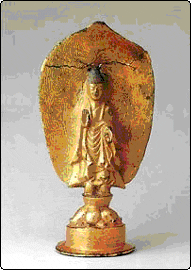
featured specific images of Buddha and a formal
organization of practitioners. Supported by kings
and their royal families, Buddhism began flourishing,
building temples at numerous locations and setting
up huge pagodas and gold-plated Buddhist statues
(inside the temples). The Buddhist monks of the
kingdom spread the religion to its neighbor, the
Silla Kingdom, while also playing a vital role in
disseminating the Buddhist region and culture to
other parts of the region, including Japan.
[Source : Korea.Net]
|
|
|
|