|
|
|
|
| |
 Lifestyles / festivals
 |
|
| |
Koguryeo's
Walls, Monuments and Tomb Murals
Many Goguryeo(Koguryo)-era cultural assets have been recognized
as world-class cultural heritage. Examples of these
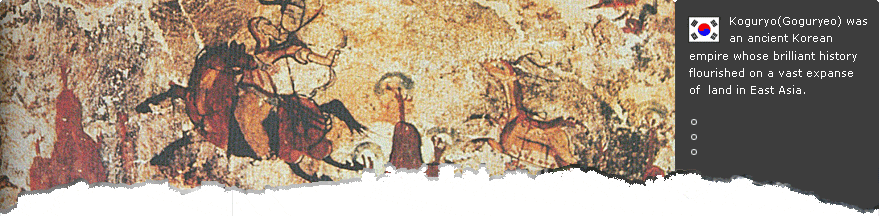
assets include tomb murals that are widely known
for their sense of using bright colors and a variety
of painted images, the 1,500-year-old fortresses
and walls that still stand high in grandeur, as
well as oversized, monolithic monuments.
The kingdom had an abundant supply of mountain
rocks. Taking advantage of this, they built robust
bulwarks at strategically important defensive
points and transportation crossroads. Its fortresses
retained the best of its architectural technology.
The "chi" around the fortress was the
protruding sections of the walls that enabled
soldiers to launch an effective three-front defense,
which of course
|
|
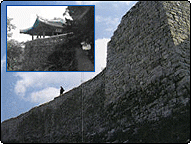
pic) Great wall of korea
|
| |
enhanced the defense capabilities of the bulwarks.
To ensure that these defense structures would
not crumble easily, they deployed solid, large
rocks at the bottom and smaller rocks for the
upper parts of the structures. Angles of the walls
were carefully laid to ensure maximum stability.
Rather than chip off cliffs or rocks, they took
advantage of natural dispositions as they were;
and when they built defensive walls they laid
the rocks in an interlocking way, a technique
to build the walls as defensively strong as possible.
The superiority of Goguryeo(Koguryo)'s architectural techniques
was widely known to neighboring countries and
influenced their culture as well. Knowing that
Goguryeo(Koguryo) fortresses were hard to breach, regional
powers would hold back from challenging Goguryeo(Koguryo).
The 1,500-year-old Goguryeo(Koguryo) ramparts are still
extant all over the old Goguryeo(Koguryo) territory.
|
|
| |
Knowing how to work with
rocks, the people of Goguryeo(Koguryo) used to build gigantic
stone tombs. The royal mausoleum of King Jangsu
(r. A.D. 413-491) is the prime example. It stands
like a pyramid that measures 31 meters each side
and stands 13 meters high, a reason that it is dubbed
the 'Pyramid of the East.' There are over 10,000
stone tombs of this style and others (stone chambers
covered with dirt on top) still extant; one of them
measures 71 meters each side. Tomb guards used to
take care of the mausoleums of kings and aristocrats
and ceremonial services have taken place on a regular
basis. |
|
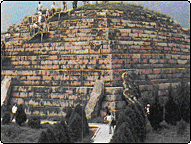
pic) Stone Tomb |
| |
Then, there is King Gwanggaeto's
Monument that stands in front of the king's mausoleum.
Built by his son, King Jangsu, in A.D. 414, this
rectangular monolith stands 6.39 meters high and
weighs 37 metric tons. A total of 1,775 Chinese
characters were engraved on all four sides of the
monument, which is widely recognized for its historographical
value today. The Chinese inscriptions describe the
"rules of care" for tomb guardians, a
brief history of the kingdom, and the genealogy
of royal families, as well as the great achievements
of King Gwanggaeto. Another Goguryeo(Koguryo)-era monument,
called "Jungwon-Goguryeo(Koguryo)-bi (the central region
monument)," was excavated in 1979 in Chungju,
South Korea. About 2,000 words were engraved on
it. Although scholars were so far able to read only
one-tenth of the inscriptions, about 200 words,
it nevertheless provided invaluable information
about how the kingdom governed its southern territories. |
|
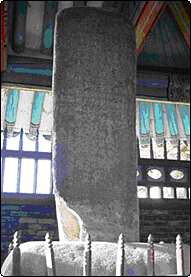
pic) Jungwon-Goguryeo(Koguryo)-bi |
| |
Finally, the representative works that epitomize
Goguryeo art are those tomb murals inside more
than 100 tumuli. Their purpose was to wish the
dead a peaceful rest and they were portrayed in
various images and contents. Popular images were
decorative patterns, mostly to decorate the tomb's
interior (or sometimes to convey particular meanings),
the portraits of lifetime events of the deceased,
deities of protection to chase off evil spirits
and to lead the soul of the dead to the afterworld,
paintings of brave gate guards, goblins, some
of heavenly features, and various constellations.
These murals vividly portray the lifestyle of
the time as well as its complex spiritual worlds,
not to mention the outstanding artistic painting
skills. For these reasons, they have won recognition
as a " world cultural heritage."
Of these tomb paintings, those found inside Anak
No. 3 Tumulus (featuring a long procession of
250 participants), the Tomb of the Dancers (hunting
scenes), the Large Gangseo Tumulus (a tortoise),
and the Middle Gangseo Tumulus (a phoenix) well
deserve to be honored as excellent examples of
the world's best artworks among their contemporaries,
given the exceptional techniques deployed in the
handling of colors and brush strokes. Also, the
paintings in the Fourth of the Five Tombs (portraying
deities and hermitic figures) still retain much
of their magnificent colors, and continue to mesmerize
viewers.
[Source: Korea.Net]
|
|
|
|