| |
Even
in its heyday, a crisis once befell Koguryo. There was
a series of confrontations among the nobility over the
succession issue in the 540s. Taking advantage of this
domestic disarray, the newly emerging nomadic power, Tuchueh,
launched an attack from the north in the 550s and Baekje
and Silla attacked from the south. Koguryo in the end
had to cede the mid-section of the Korean peninsula to
Silla and concentrated its efforts on repulsing Tuchueh,
and was victorious.
A more serious challenge descended upon Koguryo during
the second half of the sixth century. The four-power
set-up in East Asia was collapsing, when the new Sui
Empire emerged. Sui managed to unify numerous nations
competing for supremacy in the Huang and Yangtze River
regions and even destroyed Tuchueh, who had been ruling
the northeastern plains. This led Sui forces face to
face with Koguryo, which was still pursuing expansionist
policies. In preparation for a war with Sui, Koguryo
collected lots of information, spurred on weapons development,
strengthened its internal cohesion and braced itself
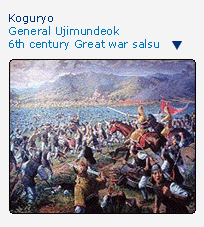
for a war. In 612, Sui attacked Koguryo with millions
of troops. Koguryo scored a major victory at the battle
of Salsu River by annihilating most of the 305,000-strong
Sui troops. Subsequently, Koguryo successfully repulsed
three more major attacks. Ultimately, this series of
defeats led to the downfall of the Sui Empire itself.
Thirty years later, Koguryo had to wage a war against
the Tang, the Chinese successor to Sui. In 645, it repulsed
hundreds of thousands of Tang forces in combats at the
western frontier's strategic points of Sinseong, Geonan
and Anshi fortresses and Mt. Jupil. The commander of
Chinese forces was King Taejong himself, known as the
greatest king in Chinese history. In 661, mobilizing
hundreds of thousands of troops, Tang again came attacking
Koguryo, but its ambitions were frustrated the following
February as the main component of Chinese forces was
routed.
[Source : Korea.Net] |
|






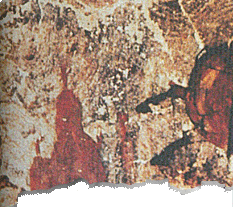




 Koguryo's
Wars with Sui and Tang
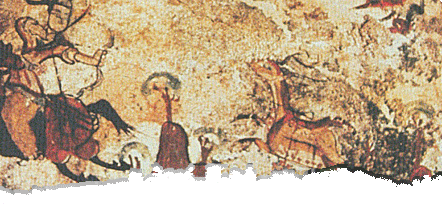
Koguryo's
Wars with Sui and Tang