|
|
|
|
| |
 Lifestyles / festivals
 |
|
| |
People
of Goguryeo(Koguryo) were fond of dancing and singing. Because
they lived in a tense society, which had to fight
wars constantly, and whose rules and laws were stringent,
the citizens understandably found a relaxing pastime
they needed in festive activities, such as drinking,
singing and dancing. Come every October, the kingdom
held various events, ceremonies and festive activities,
including the Dongmaeng Festival (whose main purpose
was to worship the gods of heaven and ancestors),
where citizens of all levels gathered and enjoyed
the event together. Unlike the memorial services
of the Chinese, characterized by rigid formalities
and solemn appearances (so as to stir up the fear
of gods among viewers), Goguryeo(Koguryo)'s events and ceremonies
(the Dongmaeng Festival, in particular) provided
a forum of festivity where people mingled with one
another, engaging in drinking, singing and dancing
activities (in celebration of the "gods' descent
to this world"). |
|
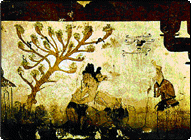
pic) Ssireum:Goguryeo(Koguryo)
form of wrestling
|
| |
In the beginning of each year, as was the custom,
many village people would join in the festive
events held at riverside locations. Kings also
used to come and watch citizens enjoying entertainment
activities, which included 'stone-throw games,'
a custom that has been handed down to the mid-20th
century.
Other popular pastime activities the Goguryeo(Koguryo)
people enjoyed included games like "baduk"
("go"), "jang-gi" (Chinese
chess), "chukguk" (soccer), dice-play,
"yut-nori" (the four-stick game), "tuho"
(throwing-arrows-in-jar), ssireum ("sumo")
and a bare-hand duel called "subak."
Subak eventually evolved into Taekwondo, Korea's
most well known martial art, as the sport passed
through the Goryeo(Koryo) and Joseon Kingdoms.
Ssireum, which has become a very popular sport
today, is a game of wrestling in which two players
compete to wrestle the other to the ground using
cloth-sashes, which are tied around the waists
and thighs of the players. People also enjoyed
circuses brought from Central Asia, listening
to musical performances, or playing musical instruments
like the six-string Korean zither or flute.
|
|
| |
Hunting was also an important
pastime. Interested individuals would form large-scale
hunting squads, and run up and down mountains and
across open fields. They would set up shooting targets
and hold archery-shooting contests. Those with outstanding
archery skills were named "Jumong," the
nickname of King Chumo who founded the kingdom,
a tag of honor. Meanwhile, young people would take
academic as well as archery lessons at "gyeongdang,"
an educational institution, receiving a balanced
training that eventually paved the way for the kingdom
to foster strong military power. |
|
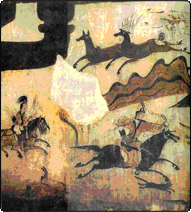
pic) Hunting |
| |
In terms of marriage customs, the kingdom had
a practice called "seo-ok-je," in which
the bride's family would build an annex ("Seo-ok')
to their house and have the new couple live there
and rear children until they fully grew up. This
custom would disappear toward the late period
of the kingdom, when it was replaced by a more
liberal concept of marriage, allowing young ones
in love to marry without undue delays.
Funerals also carried particular significance.
Large-scale funerals were favored and hefty sums
of money were paid for them. The objects that
the deceased had used during his/her lifetime
were buried together with the dead. This custom
was modified during the late period of the kingdom,
when the belongings of the dead were placed at
the side of the grave, so that funeral guests
could take them. The Goguryeo(Koguryo) people would deeply
mourn with sorrow and tears at the loss of their
loved ones; but as was the custom at the funerals,
they would 'send off' the deceased with dances,
songs and music.
[Source: Korea.Net]
|
|
|
|