| |
King
Gogukwon's successors were Kings, Sosurim and Gogukyang.
They began to overhaul the state's internal institutions
in a bid to overcome a series of crises facing Koguryo.
Kings Sosurim and Gogukyang were able to solidify state
power by firmly establishing social discipline through
administrative laws and orders, providing ground for liberal
thoughts by introducing Buddhism, and nurturing intellectuals
with the creation of Taehak (National Academy).
It was King Gwanggaeto (r. 391-413), who greatly changed
the map of Koguryo by vigorously pursuing the task of
adding new domains by conquest. The great military campaigns
of this king made Silla in the southeastern part of
the Korean peninsula a vassal state, and Baekje, Gaya
and Japan its tributary states. To the north, it overpowered
Suksin and East Buyeo and made them tributary states.
To the west, Koguryo conquered the Khitan tribe along
the middle and upper reaches of West Liao River and
destroyed the Later Yen, set up by Moyong Seonbi tribe.
King Gwanggaeto was succeeded by his son, King Jangsu.
During his 79 years on the throne, King Jangsu continued
his father's enterprises and brought Koguryo to its
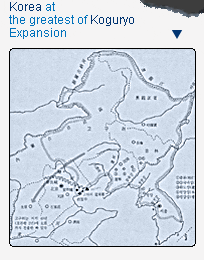
flourishing height. Koguryo's power expanded further
to the north, dividing the Jiduwu territory along the
Greater Khingan Range with the nomadic empire of Yuyen.
To the south, Koguryo exercised direct control over
a region between the Gyeonggi Bay and the Youngil Bay
in North Gyeongsang Province (the mid-section of Korean
Peninsula). Subsequently, Koguryo continued to expand
its territory until it reached the Eastern Songhua River
in the north, Mt. Uimuryeo across Liao River in the
west and the southern part of today's Littoral Province
of Russia. If its indirect control over nomadic tribes
is taken into consideration in addition to the newly
added territories, Koguryo at that time was a great
power with its sphere of influence covering a large
amount of present-day Northeast China, Russia's Littoral
Province and two thirds of the Korean peninsula. Inside
the huge sphere of influence were Khitan, Malgal (Moho),
Jiduwu, Silla and Ye in the form of vassal or tributary
states. Koguryo at this time was a great empire that
took pride as the guardian of international order and
the most sacred state under the sun.
Koguryo, in the fifth and sixth centuries, was one
of the four great powers in East Asia, along with Yuyen,
a nomadic empire; Northern Wei, a state set up by the
Seonbi tribe in the Huang River basin, and Song, a state
established by Han China in the Yangtze River basin.
Unlike Northern Wei and Song, which were persistently
buffeted by wars and other disturbances, Koguryo was
able to nurture a high quality culture, while enjoying
peace. Indeed, Koguryo culture exercised a significant
impact on Baekje, Silla, and Japan.
In early sixth century, Northern Wei, ruler of North
China, likened Koguryo to a large wine barrel, and recognized
the world of Koguryo's independent dominion east of
the Great Wall.
[Source : Korea.Net] |
|










 Koguryo
Builds Up a Great Empire
Koguryo
Builds Up a Great Empire